
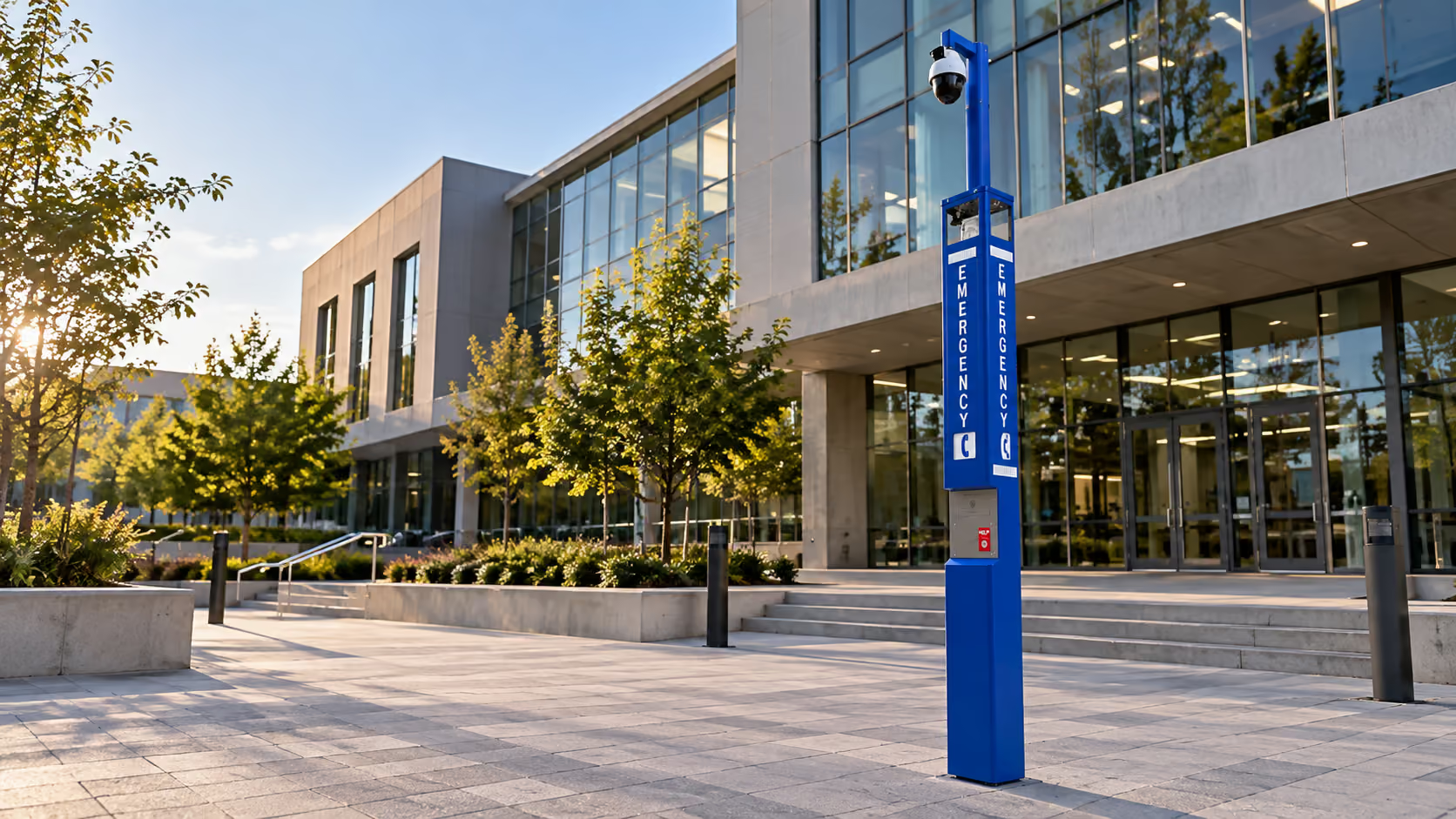
A lot of campus emergency towers installed in the 1990s and early 2000s were never built to current ADA standards. They're still standing, still lit, and still marked on the campus safety map, but whether every student on campus can actually use one is a separate question, and for facilities directors, it's the one that matters most.
Blue light call stations and campus emergency towers are not exempt from the Americans with Disabilities Act. Current requirements call for push buttons mounted at wheelchair-accessible heights, operation that doesn't require two hands or a tight grip, braille signage and raised lettering, and a visual indicator, such as a strobe or LED, alongside the audio connection. A tower that fails any of these is non-compliant, and for a public or federally funded institution, that is real legal and liability exposure, not a minor maintenance item.
This isn't theoretical. Title II of the ADA requires public entities that provide emergency telephone services to ensure direct access for people who rely on alternative communication methods, not just for callers who can stand, hear, and dial unassisted. A tower that only works for one kind of user was never fully compliant, even on the day it was installed.
For facilities directorsrunning a compliance review, or trying to decide what to do about towers thatpredate current standards, here is what the requirements actually say and whatthe practical options look like.
What ADA Compliance Requires for Emergency Call Stations
ADA requirements for emergency call stations draw from the ADA Standards for Accessible Design, specifically Section 308 for reach ranges and Section 309 for operable parts, along with Title II requirements for public entities. In practice, that translates into five specific design requirements.
1. Button Height: The Most Common Failure Point
The call button has to be reachable from a wheelchair. Under the current 2010 ADA Standards, operable parts, including push buttons, must be mounted between 15 and 48 inches above the ground for both a forward and a side reach. That's worth knowing on its own: the older 1991 ADAAG standard allowed a side reach up to 54 inches, so a tower installed and considered compliant under the old rule can be out of compliance today without anyone having touched it. This is the single most common failure point on older towers, where the call button sits at standing-adult eye level, typically 60 inches or higher.
2. Hands-Free or Single-Handed Operation
The system has to be operable with one hand, without tight grasping, pinching, or twisting of the wrist, and without requiring more than five pounds of force to activate. That rules out rotary dials and most handset-style phones. A single push-button that starts a hands-free call is the standard compliant configuration on modern emergency towers.
3. Braille Signage and Raised Lettering
Blue light phones need lettering that's raised as well as braille, placed on the labels or instructions near the call button, so a caller who is blind or has low vision can locate and operate the unit by touch.
4. Visual Indicators Alongside Audio
Audio-only feedback isn't enough for a caller who is deaf or hard of hearing. Compliant units need a visual indicator, typically a strobe or LED, to confirm a call has connected and help is on the way. Western Illinois University's 49 campus call boxes, for example, have been upgraded over time to include a flashing strobe that activates when the system is triggered, giving visual confirmation that doesn't depend on hearing anything at all.
5. Clear Floor Space
A compliant tower needs at least 30 by 48 inches of clear, level ground adjacent to the call station for a wheelchair to approach. A tower blocked by landscaping, curbing, or nearby infrastructure is non-compliant regardless of what the hardware itself can do.
ADA Compliance Checklist for Campus Emergency Towers
● Call button mounted between 15 and 48 inches aboveground (forward or side reach)
● Single push-button activation, no grasping, pinching, or twisting, and no more than 5 lbs of force required
● Hands-free audio connection; no handset to hold
● Braille signage present and legible on the instruction panel
● Raised lettering on labels, not just printed or painted text
● Visual strobe or LED indicator activates when the call button is pressed
● Clear 30 x 48 inch accessible ground surface at the tower base
● Accessible approach path to the tower: no steps, obstructions, or steep grades
● Dispatch connection tested and confirmed working within the last 12 months
● Tower location identifiable to dispatch without the caller needing to describe it
A tower that fails on button height or braille signage is non-compliant in a way that's both easy to document and hard to defend in a disability access complaint. Button height especially is visible at a glance: during a walkthrough, it's immediately obvious whether a call button was designed for a standing user or a seated one.
Retrofit vs. Replace: What Are the Options?
When an existing tower is non-compliant, facilities directors generally have two paths: upgrade the tower in place, or remove it and install one built to current standards. Which one makes sense depends on the tower's age and condition, how many compliance gap sit has, and the budget available.
When Retrofitting Makes Sense
If the tower structure itself is sound and the gaps are limited to the call station, a button in the wrong spot, missing braille signage, no strobe, a retrofit kit can usually resolve all of it at a fraction of replacement cost. The pole and base stay in place; only the call station head unit is replaced with one built to current ADA specs. TS&L's Blue Light Retrofit Kit is built specifically for this: it replaces the non-compliant call station components on an existing tower without pole removal, concrete work, or a full system reinstall.
Retrofitting typically costs significantly less than full replacement, and for institutions with a large legacy inventory, some campuses run 50 or more towers, that difference adds up fast. A retrofit program that brings every tower into compliance over a two- to three-year cycle is a realistic line item in a facilities budget. A full replacement program at the same scale is a capital project.
When Replacement Is the Right Call
If the tower structure is corroded, structurally compromised, or running communication technology that's no longer supportable, retrofitting the call station onto a failing pole doesn't make sense. Full replacement with a current, ADA-compliant Blue Light Emergency Tower is the right path once the infrastructure itself has reached the end of its life. Coastal and high-humidity climates accelerate that timeline: towers on campuses across Florida and the Southeast tend to show corrosion and weather-related wear well before their counterparts inland, which is worth factoring into the retrofit-versus-replace decision during an audit.
Replacement also makes sense when the tower needs to move. If landscaping, construction, or other site changes have blocked the accessible approach path, relocating the tower to a compliant spot requires reinstallation regardless of the condition of the existing head unit.
A non-compliant emergency tower isn't just a regulatory exposure on paper. If someone with a disability can't use a non-compliant tower during an actual emergency, and that inability is a factor in what happens to them, the institution's failure to maintain accessible emergency infrastructure becomes directly relevant in a negligence claim. That's not a hypothetical; it's a documented pattern in disability access litigation against public institutions.
What Facilities Directors Should Do Now
The practical starting point is an inventory audit. Walk every tower on the campus map against the compliance checklist above, and log the specific gaps, button height, signage, visual indicators, site accessibility, at each one. That record does two things: it shows the real scope of the problem, and it documents that the institution is actively working toward compliance rather than ignoring it.
● Photograph the call button height at each non-compliant tower; it's the simplest documentation of that specific failure
● Note the age and structural condition of each tower; this is what determines retrofit versus replace
● Map the accessible approach path at each location: ground surface, grades, obstructions
● Test the call connection and dispatch location ID at each unit; compliance is about function, not just hardware
● Prioritize remediation by risk: highest-traffic areas and locations with documented accessibility needs first
TS&L works with campus facilities teams on exactly this kind of audit-to-remediation process, identifying which towers in an existing inventory are candidates for a retrofit kit versus full replacement, and scoping the work to fit a realistic budget and timeline. TS&L supports this work for campuses across Florida, the Southeastern US, and beyond, and the Blue Light Retrofit Kit is available for direct procurement or as part of a broader campus safety upgrade program.
Frequently Asked Questions
1. Are blue light towers required to be ADA compliant?
Yes. Any emergency call installation on a public or federally funded campus must meet ADA requirements: push buttons mounted between 15 and 48 inches above the ground, hands-free single-handed operation, braille and raised-lettering signage, and a visual indicator alongside the audio connection.
2. How do I make an old emergency tower ADA compliant?
If the tower structure itself is still sound, a retrofit kit can bring the call station up to current standards, correcting button height, adding braille signage, and adding a visual strobe, without replacing the pole or base.
3. What are the ADA requirements for emergency call stations?
Push buttons between 15 and 48inches above the ground, single-handed operation with no grasping or twisting and no more than 5 pounds of force, hands-free audio, braille and raised-lettering signage, a visual strobe indicator, and a clear 30-by-48-inchaccessible ground surface at the base.
4. Is retrofitting cheaper than replacing a non-compliant tower?
In most cases, yes, and significantly so. Retrofitting replaces the call station components on an existing pole, avoiding concrete work, pole removal, and reinstallation costs. Full replacement makes sense when the tower structure itself is compromised or the location needs to change.
5. What happens if a campus emergency tower isn't ADA compliant?
It creates regulatory exposure under Title II of the ADA, and potential liability if a person with a disability can't use the tower during an actual emergency. A documented failure to maintain accessible emergency infrastructure is difficult to defend in a disability access complaint or lawsuit.
6. Does TS&L provide ADA compliance audits for campus emergency towers?
Yes. TS&L works with campus facilities teams across Florida and the Southeastern United States on tower inventory audits, retrofit kits, and full ADA-compliant tower replacements, with projects supported nationwide.
7. Need to Bring Your Campus Emergency Towers Into Compliance?
TS&L supplies blue light retrofit kits for non-compliant existing towers and full ADA-compliant blue light tower replacements, for campuses that need to close compliance gaps without replacing every pole on the property.
View the Blue Light Retrofit Kit →


.jpg)

.png)

.png)