
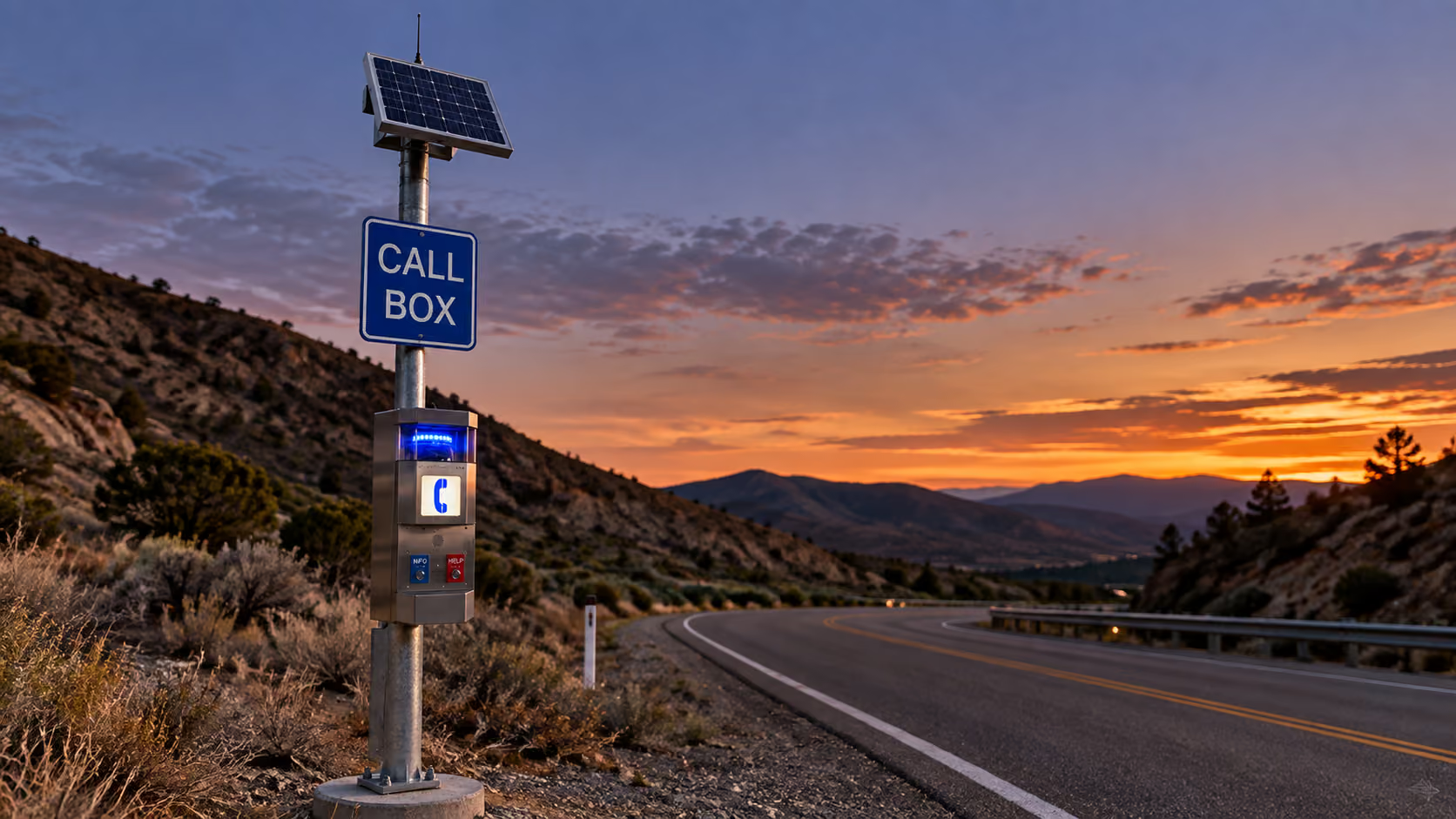
In 2001, California drivers used highway call boxes nearly 98,000 times. Within a decade, that volume had already dropped 80%, and by the mid-2020s individual county programs were logging usage in the dozens to low hundreds of calls a year. Some counties are now removing their call box networks entirely. So why are DOTs in other states still installing new ones?
The easy answer is bureaucratic inertia. The accurate answer is more interesting: highway emergency callboxes have not survived this long because nobody noticed smartphones existed. They have survived because there are specific situations, specific people, and specific locations where a fixed, dedicated, always-on highway callbox does something a cell phone cannot.
Understanding what those situations are shows exactly where call boxes remain essential in 2026, not just where they happen to still be installed. If anything, several of the conditions that make them necessary, EV adoption, network outages, ADA obligations, are becoming more common, not less.
A Brief History of the Roadside Emergency Phone
The first roadside emergency phones appeared on the New Jersey Turnpike in the 1970s, placed about every mile along the shoulder. The idea was simple: if there's trouble, help should never be more than about half a mile away. These systems spread across the interstate network through the 1980s and into the 1990s. California built the largest of them, growing at its peak to roughly 15,000 call boxes across more than 6,000 miles of highway, one of the biggest motorist-aid systems ever deployed in the US.
Then cell phones arrived. Use declined steadily through the 2000s, falling roughly 80% by 2010 alone, and the decline has continued well past that. Santa Barbara County's 47 remaining callboxes logged just 178 calls in 2025, down from nearly 8,000 in 1999, and roughly 80% of that remaining volume was maintenance tests rather than genuine emergencies. San Luis Obispo County approved a phase-out of all 41 of its remaining call boxes in 2026 after all major cellular carriers confirmed reliable coverage across the county's freeways and highways.
That decline is concentrated almost entirely in one category of road: corridors with reliable cell coverage and frequent patrols, where a call box has become redundant. It says nothing about the situations covered next, where a phone still isn't a dependable substitute.
Why "98% of Americans Have Cell Phones" Is Not the Whole Answer
The argument for removing callboxes usually leans on a well-known Pew Research figure: 98% of Americans own a cell phone, and 91% own a smartphone. It's a compelling number. It's also the wrong question.
The real question isn't whether drivers have phones. It's whether those phones work where and when they need to. And the answer to that is more complicated than the ownership statistic suggests.
• Dead Zones Are Still Real in 2026
Even the carrier with the widest 5G footprint in the country falls short of full coverage nationwide, and independent network testing consistently shows real gaps in rural stretches. Canyons, valleys, ridgelines, and dense timber still create reliable dead zones along highway corridors that see daily traffic.
Santa Maria Mayor and Santa Barbara County Association of Governments (SBCAG) board member Alice Patino made the point directly during the county's 2026 call box review: "It ravel 166 and there are a lot of dead zones on 166. I would hate to see people get stranded there." That's a sitting elected official, in 2026,arguing to keep call boxes on a specific highway because she has experienced the dead zones herself.
• The EV Breakdown Problem
Electric vehicles fail differently than gas-powered ones. They don't always run out of range gracefully, and a dead battery takes the phone charger with it. As EV adoption climbs, with US EV sales hitting record levels in 2025, the scenario of a driver with both a dead vehicle and a dead phone is becoming more common, not less. A fixed outdoor emergency call box on the shoulder does not care what your battery percentage is.
• Non-English Speakers and Vulnerable Road Users
Calling 911 requires knowing the number, communicating clearly in English or navigating a language barrier under stress, and having a charged, working phone. Not every driver on a US highway meets all three conditions. Highway emergency call boxes with push-button operation and a direct dispatch connection lower that barrier significantly. Many modern units support multiple languages and use visual indicators that confirm the system is working without requiring the caller to speak at all.
• ADA Requirements and Pedestrian Safety
Americans with Disabilities Act requirements apply to highway safety infrastructure. For drivers who cannot use a standard cell phone due to a motor, visual, or cognitive impairment, a fixed call box with large tactile controls and a direct voice connection to adispatcher provides accessibility that no smartphone app reliably replicates. This is one reason DOTs with active ADA compliance programs continue to specify call boxes on new construction.
• Network Outages Are Not Hypothetical
Cell networks fail. In September 2025, a routine firewall upgrade at Optus in Australia caused a13-hour outage that resulted in about 600 failed emergency calls and several confirmed deaths among people who could not get through. This was a major telecom provider with modern infrastructure, and it failed during routine maintenance. A solar-powered emergency call box on its own dedicated network does not share that failure mode. It is a separate system entirely.
How Modern Highway Call Boxes Actually Work
Today's highway call boxes are not the analog wired units from the 1980s. Modern freeway and tunnel call boxes are cellular-based and solar-powered, operating independently of grid power and connecting over dedicated cellular channels rather than the public network that gets congested during major incidents.
- Location-linked dispatch: each box is tied to a specific mile marker. When a caller connects, the dispatcher already knows exactly where they are, which matters enormously when a panicked or injured caller cannot describe their location.
- Always-on, no charge required: solar power with battery backup keeps the unit operational regardless of weather, grid outages, or how long it has been sitting unused.
- Direct to dispatch, not 911: many call boxes connect directly to motorist assistance centers or DOT dispatch, bypassing the 911 system and getting help onto the road faster for non-life-threatening situations.
- Blue light visibility: the characteristic blue light on modern emergency call stations stays visible at night and in poor weather from a significant distance, working as both a locator beacon and a deterrent in higher-risk pedestrian areas.
Where Fixed Emergency Communication Is Still Essential
For every situation coveredabove, tunnels, dead zones, EV breakdowns, language barriers, ADA-covered drivers, network outages, a fixed call box is still the only tool on the listthat reliably works. Removal has only made sense in the narrow slice of roads where none of those conditions apply: densely covered urban freeways with confirmed, redundant carrier coverage and frequent patrol presence. That's as mall and shrinking category, not the norm, and it describes almost none of the locations DOTs, campuses, and facility owners are actually specifying new callboxes for.
New installations make the most sense in:
- Highway tunnels, where the structure itself blocks cellular signal and a fixed communication point is a safety requirement, not an optional extra
- Remote rural highways with confirmed dead zones and low traffic density, exactly the stretches where a breakdown is most dangerous and help is furthest away
- High-pedestrian areas, parking structures, transit hubs, and campus environments, where the same blue light call box model translates directly from highway use
- Any location where ADA compliance and language accessibility are requirements that cell-phone-dependent solutions do not reliably meet
Florida offers its own data point here. The state once ran call boxes at one-mile intervals along its interstates and turnpike system, then removed the entire network by 2014 after usage fell sharply, the same pattern now playing out county by county in California. That history is exactly why the smarter investment today isn't a blanket statewide network. It's targeted deployment at the specific locations that actually need it, which is where TS&L focuses its highway and outdoor call box work across Florida, the Southeastern US, and beyond.
The shift for TS&L's Blue Light Call Box systems reflects exactly this pattern: highway and outdoor emergency communication where a fixed, visible, always-on unit fills a gap that cell coverage cannot reliably close. For indoor environments, parking structures, transit stations, or facilities that need ADA-compliant emergency communication, the K1 Mini Emergency Call Box covers the same need in a compact, purpose-built form factor. For open outdoor areas, campus quads, rooftop decks, and parking lot perimeters, that call for stronger visual deterrence, TS&L's Blue Light Emergency Tower adds area lighting and a taller, more visible presence. And for agencies weighing whether to decommission an aging call box network outright, Blue Light Retrofit Kits offer a middle path: modernizing the highest-value locations instead of losing coverage everywhere at once.
In every case, the through-line is the same: a dedicated point to call for help that does not care whether the caller has a working phone, or whether the public cellular network is congested, down, or simply unavailable when it matters most.
Frequently Asked Questions
• Do highway call boxes still work when cell phones don't?
Yes. Modern call boxes use their own dedicated cellular connection, so they keep working even when a driver's phone has no signal, is out of battery, or isn't working.
• How do highway emergency call boxes connect to 911?
Most connect to a motorist assistance or DOT dispatch center and send the caller's location automatically. If needed, the dispatcher can contact or transfer the call to 911.
• Are call boxes still used on highways in 2026?
Yes. They remain standard equipment in tunnels, remote highway corridors, documented dead zones, and other locations where a phone can't be relied on, even as some fully urban, fully covered corridors have phased theirs out.
• How far apart are highway call boxes typically spaced?
Older systems commonly placed call boxes about one mile apart. Today, spacing depends more on road conditions, coverage gaps, traffic patterns, and specific high-risk locations than on a fixed interval.
• What powers a highway call box?
Most modern call boxes run on solar power with battery backup, which keeps them operating without a grid connection, even through extended stretches of cloudy weather.
Looking for Highway or Outdoor Emergency Call Box Solutions?
TS&L supplies blue light call box systems for highway, tunnel, campus, and outdoor emergency communication, solar-powered, ADA-compliant, and built for the locations where cell coverage can't be relied on, across Florida, the Southeastern US, and beyond. For indoor emergency communication, ask about the K1 Mini.
View Blue Light Call Box Systems →
Explore the K1 Mini Emergency Call Box →


.jpg)

.png)

.png)