
A hospital never gets to choose when an emergency happens. It might be a patient in crisis in a stairwell, a storm that knocks out power, or a night shift nurse who needs help in a parking garage. In each case, the outcome depends on how quickly someone can reach the right people. Strong emergency communication systems for hospitals are what close that gap.
The risk is real. Bureau of Labor Statistics data for 2021 and 2022 shows that health care and social assistance accounted for 72.8 percent of all nonfatal workplace violence cases in private industry, about 41,960 cases. Federal rules also expect hospitals to plan for it: the CMS emergency preparedness rule requires a written communication plan with primary and alternate means of communication, reviewed and updated at least every two years.
This guide covers why planning matters, what a hospital emergency communication plan should include, how notification systems and backup procedures fit together, and where emergency call stations add protection that notification systems alone cannot. TS&L supplies emergency call systems for hospitals and healthcare facilities across Florida, the Southeast, and the rest of the United States.
Quick Answer
Emergency communication planning for a hospital means deciding in advance how staff, patients, security, and outside agencies will communicate during an emergency, including when power, phones, or networks fail. A complete plan combines notification systems that push alerts out, backup methods for when primary systems fail, trained staff roles, and emergency call stations that let anyone on campus reach help from a known location.
Why Is Emergency Communication Planning Important for Hospitals?
Hospitals are different from other buildings in three ways that raise the stakes for communication.
● People cannot always leave. Patients on ventilators, in surgery, or in intensive care cannot simply walk out. Staff have to coordinate protection, shelter in place, or evacuation, and that takes clear, fast communication.
● The campus is large and complicated. Emergency departments, parking structures, stairwells, outpatient buildings, and long corridors all create places where a person can be alone and out of reach of a nurse call button or a cell signal.
● Staff face real risk. Violence against healthcare workers is measurably higher than in other industries, and many incidents happen where there is no one nearby to see them.
Regulation adds a further reason. Hospitals that participate in Medicare and Medicaid must maintain an emergency preparedness program and communication plan under 42 CFR 482.15, and must test the plan through exercises. A plan that exists only on paper does not hold up when the building loses power at 2 a.m.
Florida and the Southeast add a seasonal factor. Hurricane season can mean widespread power loss, cellular congestion, and damaged networks, all at the moment a hospital needs to coordinate the most.
What Should a Hospital Emergency Communication Plan Include?
Federal rules set the baseline, and good plans go further. At a minimum, a hospital emergency communication plan should cover:
1. Contact information that stays current. Namesand phone numbers for staff, outside providers under arrangement, patients'physicians, other hospitals, and volunteers, with a named person responsiblefor updating the list.
2. Primary and alternate means of communications. The rule requires both for communicating with hospital staff and with federal, state, tribal, regional, and local emergency management agencies. The plan should say when each method is used and by whom.
3. A way to share patient information during an evacuation, as permitted by HIPAA, along with a way to report where patients are and their general condition.
4. A way to report the hospital's status to emergency management, including capacity, needs, and ability to help.
5. Defined roles and escalation paths. Who declares an emergency, who speaks to whom, and who answers a call for help at each hour of the day.
6. Training and regular testing. Drills that include communication failures, not only clinical scenarios.
7. Scheduled review. At least every two years, and after any real incident or drill that exposed a gap.
Emergency Notification Systems for Healthcare
When people say emergency notification systems for healthcare, they usually mean tools that send information out: overhead paging and code announcements, mass notification by text or app, radios, and clinical alert systems. These are essential for telling the whole building what is happening and what to do.
They have one limit. They push information from the hospital to people. They do not help a person who is in trouble somewhere the hospital cannot see. For that, the plan needs the opposite direction: a way for any staff member, patient, or visitor to call for help and be located instantly.
That is the job of an emergency call station. One push connects the person to dispatch or security with hands free audio, and the system identifies the location automatically, so the caller does not need to describe where they are. A plan with both layers is stronger than a plan with either one alone.
How Can Hospitals Communicate During Power Outages?
Hospitals are required to plan for emergency and standby power, and most have generators. Generators keep clinical systems running, but communication is often the first thing to degrade, because phones, networks, and cell towers all depend on power somewhere. A reliable plan layers several methods:
● Handheld two way radios for staff, with charged spare batteries and designated channels.
● Satellite phones for contact with emergency management when cellular and landlines fail.
● Traditional analog landlines. These draw power from the telephone exchange and can keep working when building power fails. Voice over IP lines depend on local power and the network, so they cannot be the only backup.
● Runners and a manual message system for areas where electronic methods are unavailable.
● Battery backed emergency call stations that keep working through an outage and can connect over more than one network.
Call stations matter here because a person in a dark stairwell or parking garage during an outage may have no radio, no signal, and no light. TS&L's Blue Light E-Phone connects over cellular, Wi-Fi, VoIP, or analog lines and includes battery backup, so the call still goes through when one network or the main power is down.
Backup Procedures and Staff Coordination
Equipment fails, so procedures matter as much as technology. Many emergency planners use a tiered approach: a primary method, an alternate, a contingency, and a last resort emergency method. Each tier should be written down, assigned to named roles, and practiced.
Hospitals typically organize responders under the Hospital Incident Command System, which gives every role a clear place in the chain of command. Staff coordination works best when:
● Everyone knows how to recognize each code and what their own role is for it.
● Call trees and radio channels are posted and tested, not just documented.
● Security, switchboard, and the incident commander have a shared way to confirm that a call for help was received and answered.
● After each drill or incident, the team reviews what broke and updates the plan.
How Can Emergency Call Boxes Improve Hospital Safety?
Emergency call boxes and call stations fill the places that notification systems and nurse call do not reach. They give staff, patients, and visitors a fixed, visible, always available way to reach help. Hospitals use them in four main places.
Inside the building
Stairwells, long corridors, elevator lobbies, and areas of refuge are common spots where a person can be alone and out of radio range. Compact wall mounted units suit these spaces. TS&L's Blue Light E-Phone mounts directly to a wall or column and is ADA compliant, and our guide to indoor emergency phones explains where each type belongs.
Parking garages and structures
Night shift staff often walk to their cars through parking structures with poor cell coverage. The K1 Mini Emergency Call Box is a compact, networked unit for interior levels, stairwells, and garage columns. Our parking garage safety guide shows how to place call stations alongside cameras level by level.
Outdoor paths, entrances, and open lots
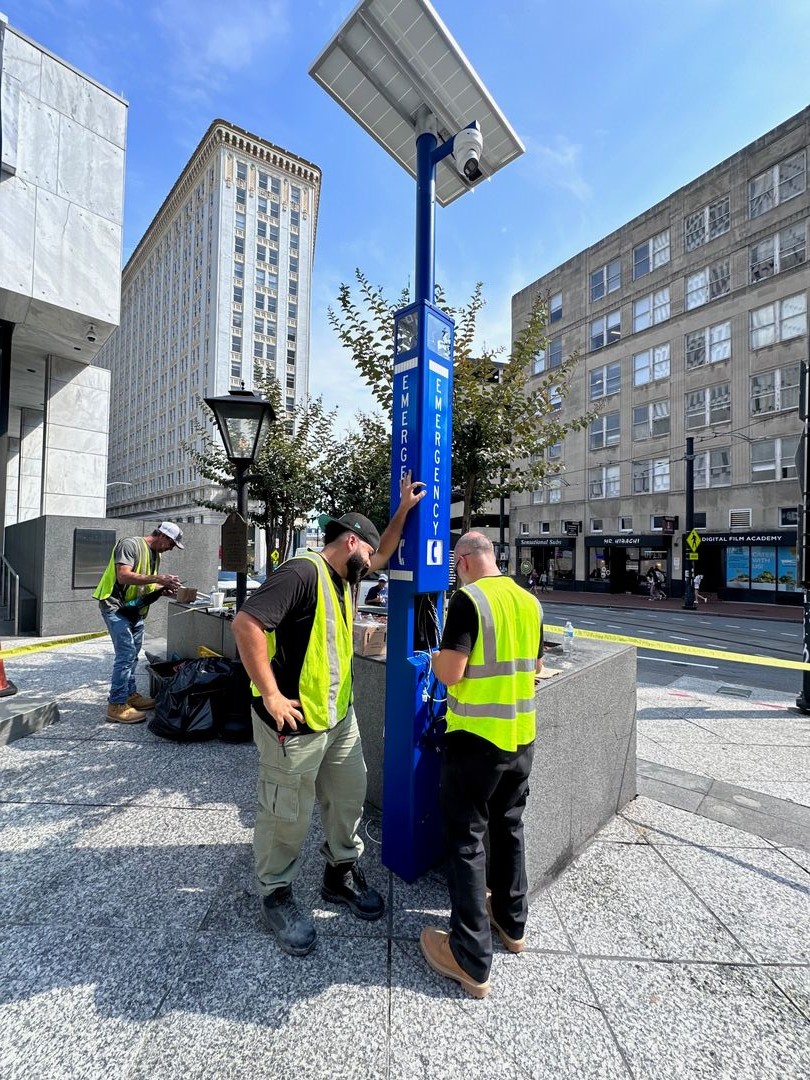
Emergency department entrances, ambulance bays, surface lots, and campus walkways need a unit that is visible from a distance. A Blue Light Emergency Tower gives staff and visitors a clearly marked place to call from and provides visible deterrence. Hospitals with older towers can modernize them with a Blue Light Retrofit Kit instead of replacing the pole, and our ADA compliance guide for campus towers covers accessibility requirements.
Behind the scenes
Loading docks, equipment areas, and remote service corridors are lower traffic and often forgotten in planning. A single call station there can be the difference between a quick response and a long delay.
Behind the scenes
Loading docks, equipment areas, and remote service corridors are lower traffic and often forgotten in planning. A single call station there can be the difference between a quick response anda long delay.
Practical Planning Tips for Hospitals and Healthcare Facilities
1. Walk the campus at night. Note every place where a staff member would be alone, out of sight, and out of signal.
2. Decide who answers. Every call station needs a named responder, a target response time, and a backup if that person is busy.
3. Connect to the systems you already have. Confirm how call station alerts will reach security or dispatch alongside your existing paging and radio systems.
4. Plan for loss of power and network. Choose equipment with battery backup and more than one connection type, and document the manual fallbacks.
5. Test on a schedule. Press the button, confirm the call connects, and confirm the location is correct. Log every test.
6. Train everyone, including new hires and contractors. A call station only helps if people know it exists and how to use it.
7. Review the plan at least every two years, and after any incident or exercise that exposes a weakness.
Frequently Asked Questions
1. Why is emergency communication planning important for hospitals?
Hospitals care for patients who cannot easily leave, operate across large and complicated campuses, and face higher rates of workplace violence than other industries. A tested communication plan lets staff coordinate quickly, reach help from anywhere on campus, and keep communicating when power or networks fail. Federal rules also require hospitals to maintain a communication plan.
2. What should a hospital emergency communication plan include?
It should include current contact information for staff and partners, primary and alternate ways to communicate with staff and emergency management agencies, a way to share patient information during an evacuation, a way to report the hospital's status, defined roles, regular testing, and a review at least every two years.
3. How can hospitals communicate during power outages?
Hospitals should use several layers: two way radios, satellite phones, analog landlines, runners, and battery backed emergency call stations. Generators keep clinical equipment running, but communication methods that depend on networks can still fail, so every plan needs tested alternates.
4. How can emergency call boxes improve hospital safety?
Emergency call boxes give staff, patients, and visitors a visible, fixed way to reach security or dispatch with one push, with the location identified automatically. They cover stairwells, parking structures, entrances, and remote corridors where radios, nurse call, and cell signals often do not reach.
5. What are emergency notification systems for healthcare?
Emergency notification systems send information out to staff and patients, through overhead paging, text or app alerts, and radios. They work best alongside emergency call stations, which let a person in trouble call in and be located.
6. Does TS&L supply emergency call systems for hospitals in Florida and the Southeast?
Yes. TS&L is based in Boca Raton, Florida, and supplies emergency call stations, blue light towers, and related safety systems to hospitals and healthcare facilities across Florida, the Southeast, and the United States. Request a quote to get started.
Build Emergency Communication Into Your Hospital Safety Plan
TS&L supplies emergency call stations and towers for hospitals and healthcare facilities across Florida, the Southeast, and the rest of the United States. Tell us about your campus and we will recommend where each type of unit belongs.
Explore Blue Light Emergency Towers →